Miami Private Community Guide
Gated Communities in Miami: Private & Guard-Gated Neighborhoods

What Are Miami's Gated and Private Communities?
Miami has a variety of residential communities with controlled, guarded, private or geographically limited access. The exact access structure varies by community, so buyers should evaluate the entrance, visitor procedures, association structure, community layout and the individual property's position rather than treating every gated community as the same.
Two Miami communities can both be described as private and offer very different arrangements. One may have a staffed entrance administered by a property owners' association; another may have a controlled gate without continuous staffing; a third may be an island reached by ferry, or a separately incorporated village. Each of those creates a different ownership experience, and each is worth verifying before a search narrows. That verification is part of what Miami buyer representation is for.
What Does "Gated Community" Actually Mean?
In practice, "gated community" is a conversational description rather than a fixed classification. It usually indicates that vehicle access is controlled in some way at one or more entrances. It does not, on its own, tell a buyer who controls the entrance, how visitors and contractors are authorized, whether the roads inside are privately maintained, or what the association can and cannot regulate.
The useful buyer question is narrower and more practical: how is access actually controlled here, and by whom? Community associations publish governing documents, and municipalities publish ordinances and resolutions that sometimes touch community infrastructure directly. Those sources answer the question; a listing description generally does not.
Gated vs Guard-Gated vs Private: What's the Difference?
These terms overlap in marketing language and separate in reality. The framing below is a way to organize questions, not a set of legal definitions — the actual arrangement must be confirmed for each community.
- Gated — a physical controlled entry may be present, and the way it operates varies.
- Guard-gated — the entrance may be staffed and may administer visitor or vehicle access, with hours and procedures that differ by community.
- Private community — a broader description that may involve access, roads, an association, geography or other characteristics, and does not automatically mean guard-gated.
- Limited-access or island community — geography or transportation creates another form of limited access, and the exact structure must be verified.
Current Private Community Inventory
Explore Homes in Miami's Gated & Private Communities
Explore current homes available within select Miami gated and private communities. Access structures, association requirements, waterfront characteristics and community rules vary, so buyers should verify the details of each property and community individually.
For the broader picture of high-end inventory and representation at that level, see our Miami luxury real estate page. A listing appearing above does not by itself establish that a community is guarded, that its roads are private, or that a property is waterfront — those characteristics are verified separately.
Why Community Access Is Only Part of the Privacy Equation
Privacy is not delivered by a single feature. It accumulates across several layers, and a buyer who evaluates only the entrance is evaluating one of them. None of these factors guarantee privacy or security; they simply describe the conditions that shape the experience of a particular home.
- 01Community — how access is administered
- 02Entry structure — entrances, visitor and contractor procedures
- 03Community layout — street pattern and through traffic
- 04Property position — where the lot sits within that pattern
- 05Lot and building position — setbacks, orientation, neighbor proximity
- 06Waterfront position where applicable — exposure and visibility from the water
- 07Individual property design — landscaping, architecture, outdoor space

Gables Estates
Gables Estates is a waterfront residential community in the City of Coral Gables, on and along Biscayne Bay. It is governed by Gables Estates Club, Inc., a private property owners' association with recorded declarations of protective covenants, which is the source buyers should read for how the community is administered. Homes here are predominantly large single-family estates on generous lots, many with water frontage.
Because the association administers covenants and community access, purchases typically involve reviewing association documents and any applicable procedures in addition to standard contract work. Waterfront questions — dockage, depth, the route to open water — are separate from community questions and belong to the property itself. Further neighborhood context is available on our Gables Estates community page.
Cocoplum
Cocoplum is a residential community in Coral Gables organized around canals and bay frontage, governed by a homeowners' association. A guardhouse exists at the community's entrance: the City of Coral Gables approved a capital appropriation for improvements to the Cocoplum guardhouse in a published resolution, which is the kind of primary record that documents infrastructure rather than procedure. Municipal records of this type are searchable through the city's legislative records portal.
Cocoplum contains both waterfront and non-waterfront homes, and the waterfront lots differ in frontage, canal position and access. Buyers comparing homes inside the community should treat those as distinct property categories rather than a single inventory; our Cocoplum community page covers the area in more depth.
Tahiti Beach
Tahiti Beach is a small enclave associated with the broader Cocoplum area of Coral Gables rather than a separate municipality, and it is frequently discussed as though its arrangements are identical to Cocoplum's. They should not be assumed to be. Plat records, association documents and any separate access arrangements are worth confirming through Miami-Dade County records and the relevant association before drawing conclusions, particularly on questions of access, shoreline and common areas.
Snapper Creek Lakes
Snapper Creek Lakes sits in southern Coral Gables between Old Cutler Road and Red Road, organized around two lakes and governed by Snapper Creek Lakes Club, Inc. The club describes the community as comprising 124 lots with a private marina. The City of Coral Gables also recognizes Snapper Creek Lakes as a site-specific zoning designation tied to the community's protective covenants, which means municipal zoning material is a useful companion to the association's own documents.
Old Cutler Bay
Old Cutler Bay is a residential community in the southern part of Coral Gables near Biscayne Bay. It is widely described in real estate material as a limited-access community, but published municipal or association documentation is the appropriate source for how access, roads and covenants actually operate there. Where a claim cannot be sourced, it is better treated as an open question for due diligence than as a community feature.
Hammock Lakes and Other Private Communities
Coral Gables also contains several smaller association-governed communities, including Hammock Lakes and Hammock Oaks. These are governed separately from one another — Hammock Oaks through its homeowners' association and an associated community development district, Hammock Lakes through its own association, with a related special taxing district recognized by the city. The practical point for buyers is that adjacent communities with similar names can have entirely different governing and funding structures, and both affect ownership costs and decision-making.
Buyers weighing these areas against other parts of the city may also find our comparison of the best neighborhoods in Miami to buy a house useful for the broader location decision, which is a different question from community access.
Miami's Private Island Communities
Miami's island communities introduce a form of limited access created by geography rather than by a gate alone. That geography can also change ownership logistics: deliveries, contractor scheduling, construction access and, in some cases, transportation itself. Parcel-level geography and waterfront boundaries can be checked through the Miami-Dade County Property Appraiser.
Star Island
Star Island is a neighborhood of the City of Miami Beach on a man-made island in Biscayne Bay, consisting of a small number of individually platted waterfront lots reached from the MacArthur Causeway. It is a single-family island community rather than a club-managed island, and municipal jurisdiction sits with the City of Miami Beach. Buyers should verify roadway status and any access arrangements through city records instead of assuming them; further context is on our Star Island community page.
Indian Creek Island
Indian Creek is unusual in that it is not merely a community — it is an incorporated municipality, the Village of Indian Creek, with its own mayor and village council, village administration, building department and police department. For a buyer, that means the entity administering the island is a local government with published officials and procedures, rather than a private association alone. Permitting and municipal requirements should be reviewed through the village directly.
Fisher Island
Fisher Island is a barrier island in Miami-Dade County with no road connection: access is by ferry or by vessel, and the Fisher Island Club states that boarding requires pre-arranged clearance. That arrangement is described on the club's own island transportation page. Ownership there is largely condominium and club-associated rather than the single-family estate pattern of a mainland gated subdivision, which makes it a different ownership decision as much as a different address — the condominium side of that comparison is covered in our guide to the most expensive condos in Miami.
How Do Waterfront and Gated Communities Overlap?
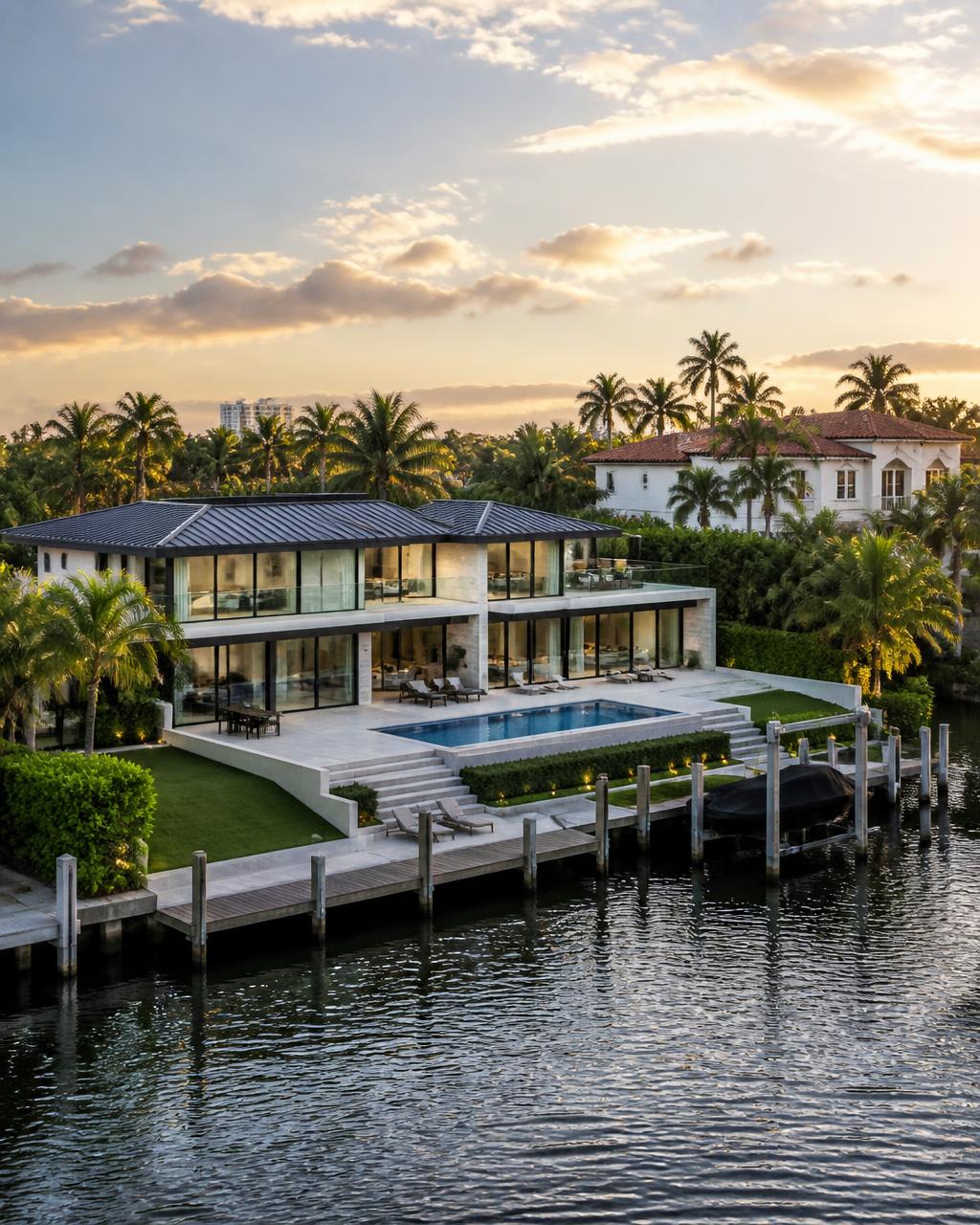
They overlap often in Miami, which is why the two are so easily conflated. Several of the communities above contain significant waterfront property. But private does not mean waterfront, and waterfront does not mean private: there are non-waterfront homes inside waterfront communities, and there is extensive waterfront property in areas with no controlled access at all.
When waterfront is part of the decision, the technical questions — dockage, water depth, seawall condition, fixed bridges and clearance, navigability and the route to open water — belong to the property, not the community. Those are covered in depth in our guide to buying waterfront property in Miami, and the estate-versus-condominium version of the choice is worked through in our luxury condo versus waterfront estate comparison.
What Should Buyers Know About HOAs and Community Rules?
Where a community is association-governed, the governing documents describe what ownership actually involves. Florida homeowners' associations operate under Chapter 720 of the Florida Statutes, while club corporations and special districts follow their own structures. Not every community has every provision below, so the list is a checklist of what to look for rather than a description of any one community.
- Declaration, bylaws, articles and any recorded covenants
- Dues, assessments and how capital projects are funded
- Architectural controls and renovation approval procedures
- Construction hours, contractor access and vehicle rules
- Guest and delivery procedures
- Leasing provisions and property-use restrictions
- Any purchase or occupancy approval procedures that apply
In Coral Gables, municipal architectural review can apply alongside association requirements, so buyers planning renovation should confirm both layers with the City of Coral Gables and the association before committing to a scope of work.
How Do Visitor and Contractor Access Rules Differ?
Access procedures vary widely, and they are worth understanding before rather than after closing — particularly for buyers planning renovation, frequent guests or property management from a distance. Rather than assume, ask the association directly how the community operates in practice.
- How residents and household staff enter
- How visitors are authorized, and by whom
- How deliveries and service vehicles are handled
- Whether contractor access requires registration or scheduling
- Whether construction hours or noise provisions apply
- How events with multiple guests are handled
How Does the Individual Property Affect Privacy?
Community access sets a baseline; the individual property determines the daily experience. Two homes on the same street can feel entirely different depending on where they sit and how they are designed, which is why shortlists built purely on community name tend to get revised after the first tour.
- Lot position — interior, corner, cul-de-sac or entry-adjacent
- Through traffic on the street and the community's circulation pattern
- Neighbor proximity, setbacks and sight lines between properties
- Waterfront exposure and visibility from the water where applicable
- Landscaping maturity, screening and topography
- Home orientation, outdoor-space position and architecture
- Adjacent development, redevelopment potential and future construction nearby
None of these is universally better. A cul-de-sac position reduces through traffic but can limit frontage options; a wide open-bay lot offers views and exposure at once; a larger lot adds separation and maintenance. The tradeoffs depend on how a buyer intends to live in the property.
How Should Buyers Compare Homes in Private Communities?
A useful comparison holds the variables constant across candidates instead of comparing one community's reputation against another property's photographs.
- 01Community — structure and character
- 02Access — how entry is administered
- 03Location — commute, schools, services, proximity to water
- 04Property — condition, age, layout, renovation history
- 05Lot — size, position, orientation, privacy
- 06Waterfront where applicable — frontage, dockage, access
- 07Association — documents, governance, approval procedures
- 08Rules — architectural, leasing and use provisions
- 09Ownership costs — dues, assessments, insurance, maintenance
- 10Intended use — how the buyer actually plans to live there
Buyers newer to the market may want to read this alongside our guide to buying property in Miami, which covers the transaction itself from search through closing.
What Should International and Out-of-State Buyers Consider?
Buying into a private community from a distance adds coordination rather than complexity. Remote evaluation works when someone locally is verifying what photographs cannot show: the position of the lot, the character of the street, the condition of shared infrastructure and the substance of the association's documents.
- Remote property evaluation, video tours and a local representative at showings
- Confirming how community access works for non-resident owners and their guests
- Reviewing association documents and any approval procedures early in the timeline
- Inspections, and waterfront due diligence where the property is on the water
- Financing differences for foreign nationals and out-of-state buyers
- Closing logistics, remote signing and funds transfer
- Property oversight, maintenance and management between visits
Buyers should also engage appropriate legal and tax professionals for their circumstances; this guide does not provide legal or tax advice.
Explore Miami's Private Residential Market
Choosing a private Miami community involves more than finding a gate at the entrance. Access, community structure, association rules, waterfront characteristics and the position of the individual property can all affect the ownership experience. Comparing the communities and current homes that fit the way you want to live — with Miami real estate agents at Supreme Capital verifying what each community and property actually offers — is what turns a shortlist into the right purchase.
Next Step
Explore Miami luxury real estate
Browse high-end homes and residences across Miami's private and waterfront communities.
Work with a Miami buyer's agent
Have access, association and property questions verified on the communities you shortlist.
Search Miami properties
Filter current MLS inventory by area, price and property type.