Miami Beach Market Intelligence
Miami Beach Real Estate Market Overview
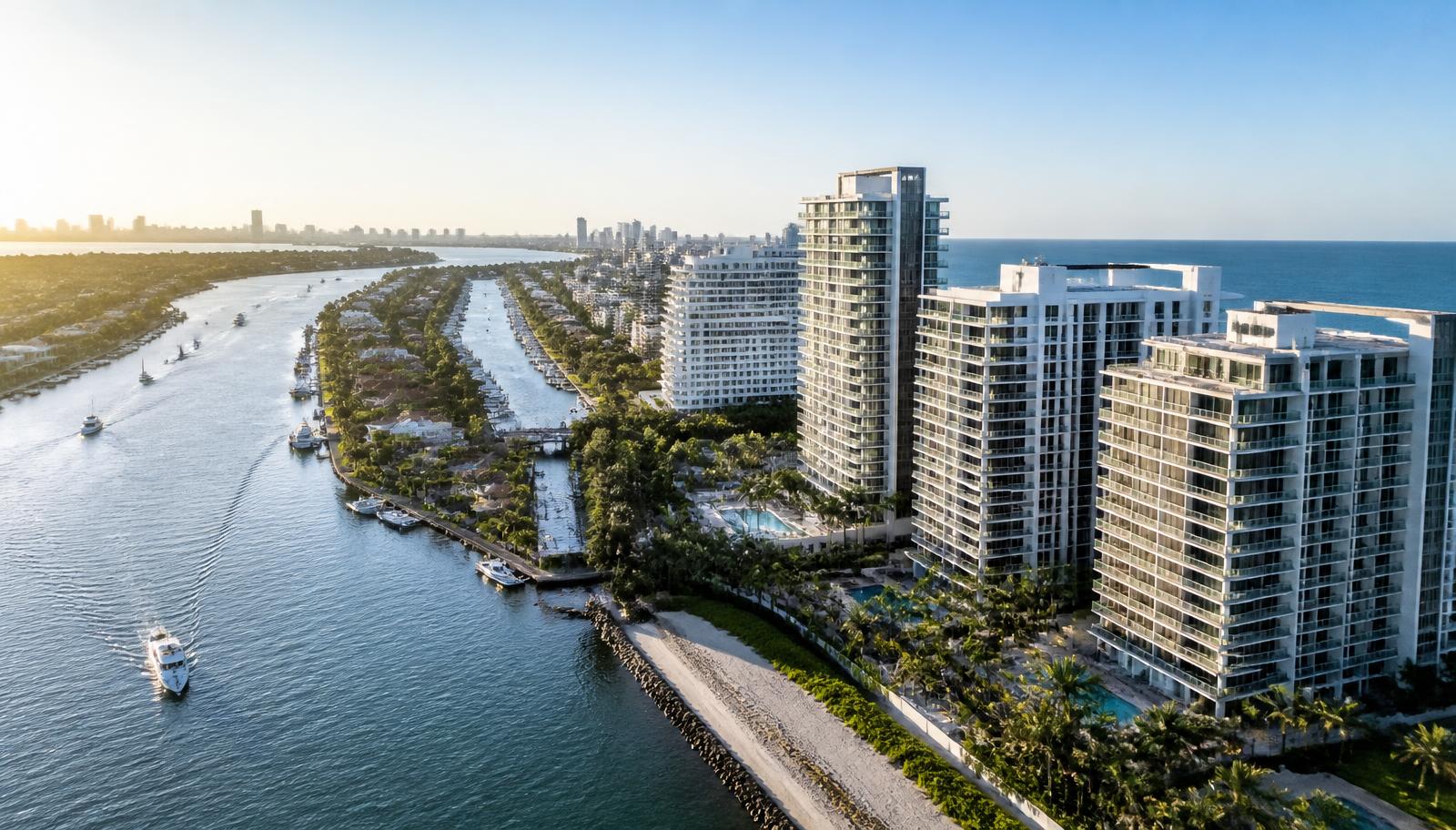
What Is the Miami Beach Real Estate Market Like?
There is no single Miami Beach real estate market. Condo conditions can differ from single-family homes, South of Fifth can behave differently from Mid-Beach or North Beach, and even two residences in the same building can compete differently because of floor, view, condition and other property-specific characteristics. This overview explains how to interpret the market rather than publishing figures that age quickly.
Miami Beach spans a barrier island and adjoining islands that hold very different residential environments: oceanfront condominium towers, mid-century buildings, Art Deco blocks, walkable low-rise neighborhoods, bayfront homes and guard-gated island estates. Those environments attract different buyers, so they can move at different speeds even within the same month. For neighborhood orientation and property discovery, the Miami Beach community page is the better starting point; this article stays with market interpretation.
Why Miami Beach Is Not One Real Estate Market
A market exists wherever a defined group of buyers chooses between a defined group of alternatives. By that definition, Miami Beach contains many markets at once. A buyer comparing two-bedroom residences in oceanfront towers is not competing with a buyer comparing bayfront houses on a residential island, and neither is competing with a buyer looking at a renovated unit in a smaller North Beach building.
That is why analysis has to narrow before it becomes useful. Each step below removes properties that are not genuinely competing, until what remains actually describes the decision in front of you.
- 01Miami Beach
- 02Submarket
- 03Property type
- 04Building or street
- 05Property characteristics
- 06Current competition
- 07Recent comparable sales
What Numbers Actually Matter in the Miami Beach Market?
Several measurements together describe a market better than any single one: price levels, inventory, days on market, sales activity, the relationship between asking and sale prices where reliable, and the mix of property types and submarkets those transactions came from. The general meaning of each metric — and its limits — is covered in our guide to reading Miami real estate market metrics. This page applies those concepts to Miami Beach specifically.
Where present-day conditions across the broader Miami market are the question, our current Miami real estate market page is where we track what is happening now. Deliberately, this overview keeps volatile figures to a minimum so its framework stays accurate over time.
How Should Buyers and Sellers Read Miami Beach Prices?
Price statistics describe groups of sales. The median is the midpoint of the sales in a dataset; the average is affected by the mix of properties that happened to close; price per square foot compresses many variables into one figure; and an asking price is a position taken by a seller, not a measurement of value.
Median Sale Price
- What it tells you
- The midpoint of completed sales in a defined dataset, for a defined geography, property type and reporting period.
- What it does not tell you
- What a particular Miami Beach residence is worth, or that every property changed in value by the same amount.
Price Per Square Foot Is Context, Not the Entire Valuation
Price per square foot is a comparison tool that assumes the properties being compared are otherwise similar. In Miami Beach, they often are not. For condominiums, the building, floor, view, exposure, condition, layout, terrace area, parking, association standing and the units currently competing can each move value independently of size. For houses, land, location, waterfront position, lot dimensions, condition, architecture and privacy do the same.
Used carefully, price per square foot narrows a range. Used alone, it can equate two properties that a buyer would never consider interchangeable.
What Does Inventory Tell You About the Market?
Inventory describes buyer choice: how many properties are available in a defined dataset and period. Raw island-wide inventory, though, mixes together properties that do not compete. It becomes meaningful when segmented by property type, submarket, price segment, building for condominiums, and property characteristics for houses.
What Does Days on Market Actually Mean?
Days on market gives context about how the market responded to a property, according to the exact definition used by the dataset. It is a starting point for a question rather than an answer in itself: original pricing, subsequent price changes, condition, property type, building, submarket, the current competitive set and the size of the buyer pool all shape it.
Days on Market
- What it tells you
- How long properties in a dataset were exposed to the market before securing a buyer, over a defined period.
- What it does not tell you
- Why a particular property has not sold, or how long a different property will take.
Why Property Type Changes the Market Analysis
Blending every Miami Beach residential sale into one narrative hides the structure of the island. The condominium market, the single-family market and the waterfront home market are evaluated through different variables and answer to partly different buyers.
Condo Market
Building
Unit
Association
Current building competition
Analysis starts with the building, then moves to how the specific residence sits within it.
Single-Family Market
House
Land
Street and location
Condition
Current property competition
Analysis starts with land and location, then condition, architecture and privacy.
Waterfront houses form a third analytical category: house, land, waterfront type, water access, property characteristics and the waterfront properties currently competing. A comparison of the condominium and estate segments at the luxury end is covered in our luxury condo versus waterfront estate comparison.

How Is the Miami Beach Condo Market Different?
The Miami Beach condominium market is best evaluated at three levels: submarket, building and unit. At the building level, relevant factors include age and condition, association governance and finances, reserve position, assessment history, insurance, amenities, parking and rental rules where applicable. At the unit level: floor, view, exposure, layout, condition, renovation level, outdoor space and the specific residences currently competing within the same building.
Why the Building Matters in the Condo Market
Two towers on the same street can be in genuinely different market positions. One may have recently completed structural work and funded reserves; another may have work pending. One may have five comparable units available; another none. Those differences reach the buyer as cost, certainty and choice.
Building-level due diligence — documents, budgets, minutes, inspection status and association finances — is a full process in itself, and it is set out step by step in our Miami condo buying guide.
How Is the Miami Beach Single-Family Home Market Different?
Houses are analyzed as house plus land plus location. That includes the lot and its dimensions, the street and the residential environment around it, condition and renovation level, architecture, privacy, waterfront position where applicable, the properties currently competing and the recent comparable sales that actually resemble the property.
How Does Waterfront Change the Market Analysis?
Waterfront is not one uniform category. Bay frontage, canal or waterway frontage and oceanfront positions are different products, and within them the relevant differentiation can include water depth, dockage, bridge and route conditions for boating access, frontage width, orientation and light, privacy, seawall or shoreline condition, and the condition of the house itself.
The technical evaluation — dockage, water depth, bridges and clearance, seawalls and shoreline, flood considerations and insurance — belongs in our waterfront homes for sale in Miami guide, and flood zone information for a specific address can be checked through the FEMA Flood Map Service Center.
How Do Miami Beach Submarkets Differ?
Miami Beach should be segmented geographically before broad conclusions are applied. The city includes South Beach and the South of Fifth area within it, Mid-Beach, North Beach, and the residential islands and waterfront streets connected to them. Each contains a different mix of building stock and property types, which is the practical reason conditions can differ.
One point of accuracy worth stating plainly: Surfside, Bal Harbour, Bay Harbor Islands and Sunny Isles Beach are separate municipalities north of Miami Beach. Data and commentary about those areas does not describe the Miami Beach market.
How Should You Read the South Beach Market?
South Beach holds a condominium-heavy inventory base across a wide range of building ages and styles, from historic Art Deco structures to later towers. Within it, position matters: proximity to the ocean, the bay or the walkable corridors; whether a building is oceanfront or interior; the condition of both the building and the unit; parking; rental rules where applicable; and how many comparable residences are competing at that moment. Neighborhood context is on the South Beach community page.
How Should You Read South of Fifth?
South of Fifth is the residential area south of Fifth Street at the southern tip of South Beach. It is a compact geography with a concentration of condominium buildings, including waterfront and oceanfront product, alongside smaller residential blocks. Because the area is small, the number of genuinely comparable residences available at any moment can be limited, which makes building-level and unit-level comparison more important than area-wide generalization. Views, floor, exposure, condition and recent comparable sales within the same building typically carry more weight here than any island-wide figure.
How Should You Read Mid-Beach?
Mid-Beach mixes oceanfront condominium buildings of varying ages, more recent development in parts of the corridor, and single-family and waterfront residential streets toward the bay. That combination means two properties a few blocks apart can sit in different segments entirely. Building age, condition, amenity level, lot and waterfront characteristics, and the properties currently competing are the variables that separate them. The Mid-Beach community page covers the area in more detail.
How Should You Read North Beach?
North Beach contains its own building stock, including mid-century condominium buildings, oceanfront properties, established single-family neighborhoods and newer projects in parts of the area. Reading it accurately means looking at what is actually available: which building, in what condition, with what association standing, at what position relative to the ocean or bay, and against what competition. Area-level labels about value or potential are not a substitute for that analysis, and the North Beach community page gives the neighborhood context.
How Should You Read Miami Beach's Island and Waterfront Home Markets?
Miami Beach's residential islands — including Star Island, Palm Island, Hibiscus Island, the Sunset Islands, the Venetian Islands and La Gorce — are distinct single-family environments rather than one category. They differ in lot sizes, frontage, water access, bridge and route conditions, privacy, architecture and how frequently properties trade. Not every island property is guard-gated, boat accessible, deep water or directly on open bay, and those characteristics should be verified property by property rather than assumed from the address.
Because these properties trade infrequently, comparable sales analysis often reaches across a longer time window and a wider geography, with careful adjustment for differences in land, frontage and condition.
How Does New Construction Affect the Miami Beach Market?
New development changes the competitive landscape rather than guaranteeing any outcome. New inventory can absorb demand in a price band for a period, set expectations for finishes, amenities and building systems, and compete directly with resale properties aimed at a similar buyer. Delivery timing, developer inventory release and project-specific pricing all influence how much that competition is felt at any moment.
New is not automatically better, safer or a stronger investment; it is a different product with different tradeoffs. The pipeline side of the question is covered in our Miami new developments overview, and the purchase process itself in our new construction buyer guide.
How Do Condo Reserves, Assessments and Building Conditions Affect Marketability?
For condominiums, building condition and association finances are part of the market picture because they affect ownership costs, buyer confidence and competitive positioning. Florida law establishes milestone inspection requirements for certain buildings and requires structural integrity reserve studies for associations that fall within its scope, with reserve funding obligations tied to those studies. The current requirements, including subsequent amendments, are published in the Florida Statutes governing condominium associations and administered through the Florida Department of Business and Professional Regulation. Local building recertification requirements are administered by Miami-Dade County and, within the city, the City of Miami Beach Building Department.
What this means for market analysis is specific rather than categorical. Reserve position and inspection status do not automatically determine marketability, and financing outcomes are property-specific, building-specific, buyer-specific and lender-specific. The reliable approach is to read the actual documents for the actual building: budgets, reserve studies, inspection reports, minutes and any assessments already levied or contemplated.
What Does the Miami Beach Market Mean for Buyers?
It means translating market data into questions about a specific property. The useful ones are narrow:
- How much relevant inventory do I actually have in this property type and submarket?
- Which properties genuinely compete with the one I am considering?
- How long have comparable properties taken to secure a buyer?
- Have competing properties reduced price, and why?
- What have genuinely comparable properties recently sold for?
- How does this building compare with nearby buildings on condition, finances and rules?
- How does this residence compare within its own building on floor, view, exposure and condition?
- For houses: how do the lot, location, waterfront position and condition compare?
- Is this property fairly positioned relative to the alternatives available right now?
Property-type guidance and current Miami Beach inventory are in our Miami Beach condos and homes for sale guide, and the analysis behind an offer is part of our buyer representation.
What Does the Miami Beach Market Mean for Sellers?
The same discipline applies in reverse. Island-wide conditions matter far less than the specific set of properties a buyer will see alongside yours in the same week.
- What is my property actually competing against right now?
- What have truly comparable properties sold for, and how recently?
- How long did those properties take, and were they originally priced accurately?
- How does my condition and presentation compare with the current alternatives?
- For condominiums: how does my residence compare within the building on line, floor and exposure?
- For houses: how do my lot, location and property characteristics compare?
- What is the current buyer pool responding to in this segment?
That analysis is the substance of a property-specific Miami home valuation, and it informs the positioning work behind our seller representation.
How Should You Evaluate One Specific Miami Beach Property?
Bring the whole framework down to a single address. Each step removes noise until what remains is evidence about one property.
- 01Miami Beach
- 02Submarket
- 03Property type
- 04Building or street
- 05Property characteristics
- 06Current competition
- 07Recent comparable sales
- 08Property-specific position
What Makes a Sale Genuinely Comparable?
Same city does not make a sale comparable. Same neighborhood does not automatically make it comparable. Same building does not make two residences identical, and same square footage does not make two properties equivalent. A comparable sale should be comparable for a reason you can state: similar property type, similar location and position, similar characteristics and condition, and a recent enough date that conditions have not materially changed.
Recorded transfers and property characteristics can be verified through the Miami-Dade County Property Appraiser, and any current market statistic used in a valuation should carry its source, geography, property type and reporting period — for example the market reports published by Florida Realtors.
Explore Miami Beach Real Estate
Understanding the Miami Beach market starts with narrowing the analysis to the property that actually matters. Submarket, property type, building or street, condition, current competition and recent comparable sales provide far more useful context than a broad Miami Beach average alone. Broader Miami real estate representation, across the island and the mainland, is what Supreme Capital Real Estate does day to day.
Property-Level Analysis
Request a property-specific Miami Beach valuation
See what comparable sales and current competition say about your property.
Buyers can start with buyer representation, sellers with selling strategy, and anyone comparing available property with the Miami Beach buyer guide.